Validation Matrix
This page tracks the publication-facing validation lanes for dkx. The goal
is to connect each physics claim or benchmark figure to:
a literature anchor,
the script or workflow that generates it,
the expected output artifact,
and the claim status recorded in the release manifest.
Machine-readable manifest
The corresponding machine-readable manifest lives in:
examples/publication_figures/validation_manifest.json
That file is the stable spine for:
future manuscript figure generation,
reproducible benchmark reruns,
and test/benchmark dashboards that distinguish implemented release lanes from deferred post-release research lanes.
Each manifest lane carries explicit research gates:
source_code: the implementation files that define the lane,tests: the tests that protect the lane or its scaffold,acceptance_gates: the concrete criteria required before the lane can support a manuscript or release claim.release_gate: the release-facing claim status, evidence level, nonblocking release decision, and promotion gate for the lane.
The schema is enforced by tests/test_validation_manifest_schema.py. Implemented
release lanes must point to existing scripts, artifacts, source files, and tests.
Deferred post-release lanes are closed for the tagged release but retain literature
anchors, implementation targets, tests, and acceptance criteria so follow-up research
work is not lost. python -m dkx.validation.release check-gates applies the same path
hygiene to deferred lanes: listed source files, tests, scripts, and artifacts must
exist even when the claim status is closed_deferred.
Release claim gate metadata
Every manifest record has a release_gate block checked by
python -m dkx.validation.release check-gates and tests/test_release_gate_metadata.py.
The allowed claim_status values are:
release_ready: checked-in artifacts support the documented release-scope claim, and the listed tests are the fast gate for that claim.regression_scaffold: checked-in bounded artifacts are useful for CI, branch validation, or manuscript layout, but a broader/full-resolution claim is intentionally not being made.bounded_proxy: checked-in artifacts support a narrower proxy or normalization claim, while the corresponding full literature reproduction stays closed until its promotion gate is met.closed_deferred: the lane is explicitly closed for the tagged release as post-release or nightly research work.
No manifest lane may set blocks_current_release=true unless the release
process intentionally stops on that lane. A lane that is not ready must
therefore be either absent from the release manifest or recorded as
closed_deferred with a concrete reason and promotion gate. This prevents
scaffold scripts, run plans, or proxy figures from being mistaken for closed
publication evidence.
Release decision
The release is shippable only for the documented release-ready and bounded-proxy claims. Production-resolution QI CPU/GPU seed ladders, true differentiable device-QI closure, and single-case multi-device strong scaling are not release blockers because they are explicitly scoped as bounded or deferred research lanes. They should be promoted only after checked artifacts satisfy the listed residual, output, trace, parity, and scaling gates.
Implemented literature reproductions
These lanes already have scripts and figure artifacts in the repository.
Publication validation dashboard
Literature anchor:
Script:
examples/publication_figures/generate_validation_dashboard.py
Artifacts:
examples/publication_figures/artifacts/dkx_publication_validation_dashboard_summary.jsondocs/_static/figures/paper/dkx_publication_validation_dashboard.pngdocs/_static/figures/paper/dkx_publication_validation_dashboard.pdf
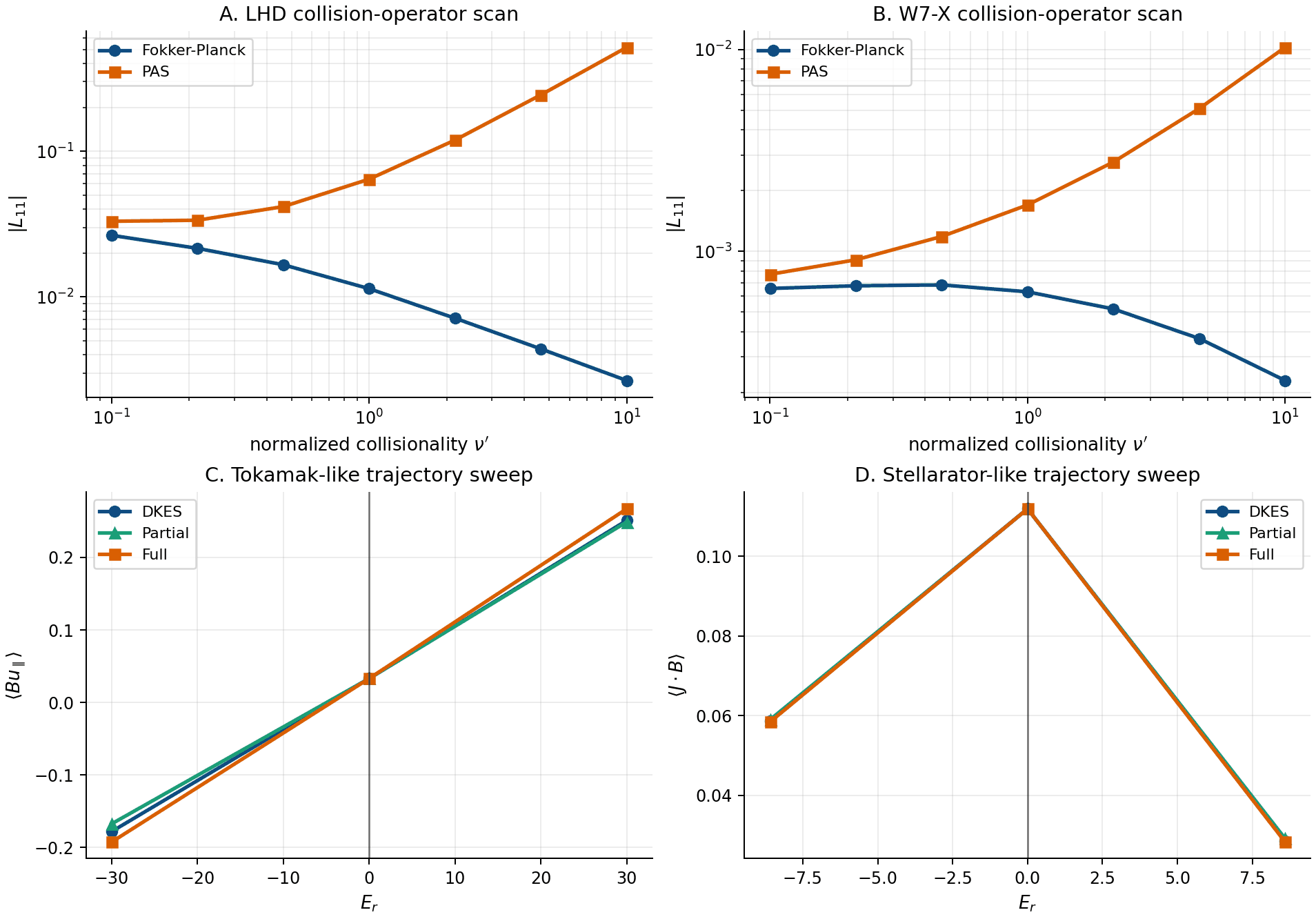
Dashboard assembled from checked-in validation artifacts rather than hand-edited
plot data. The acceptance tests assert that the collisionality scans contain both
FP and PAS rows on the seven-point grid, that the high-collisionality L11
separation remains larger than the low-collisionality separation, and that the
trajectory sweeps retain exact zero-field agreement while resolving finite-field
model separation.
Fortran v3 CPU/GPU suite benchmark
Literature and reference anchors:
Script:
examples/publication_figures/generate_fortran_suite_benchmark_summary.py
Artifacts:
examples/publication_figures/artifacts/dkx_fortran_suite_benchmark_summary.jsondocs/_static/figures/paper/dkx_fortran_suite_benchmark_summary.pngdocs/_static/figures/paper/dkx_fortran_suite_benchmark_summary.pdf
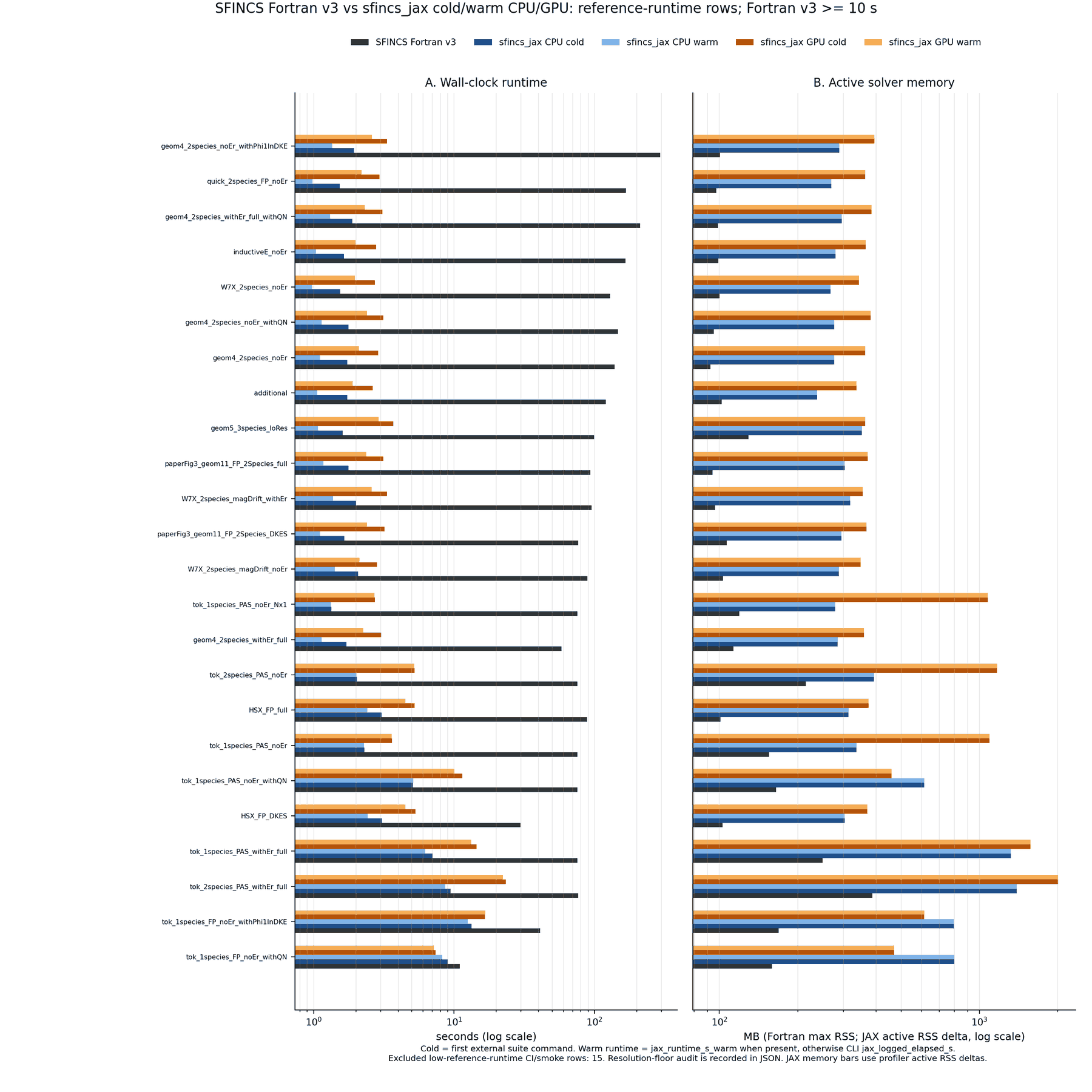
Cross-code release benchmark generated from frozen CPU/GPU suite reports. The
plotted bars show wall-clock runtime and active solver memory for SFINCS
Fortran v3, dkx CPU cold/warm, and dkx GPU cold/warm
across the reference-runtime-window rows whose Fortran v3 reference runtime
is at least 10 s. The summary JSON records which frozen rows are excluded
from public performance claims until production-resolution reruns exist. JAX active memory subtracts the fixed Python/JAX/XLA runtime
baseline using profiler RSS deltas while preserving full process RSS in the
JSON audit fields. Cases are ordered by best warm dkx speedup over the
Fortran v3 runtime. The acceptance tests require all 39 audited cases to remain
parity_ok on both backends, with zero strict mismatches and no
jax_error or max_attempts failures. Absolute runtime, memory, ratios,
top offenders, warm timing-source counts, and the excluded short-reference
rows are recomputed from the checked-in reports and stored in the JSON summary
for manuscript tables and regression triage. The excluded short-reference
rows remain CI parity/smoke checks until rerun at production-comparison
resolution.
SFINCS 2014 collisionality figures
Literature anchor:
[Landreman et al. 2014](https://publications.lib.chalmers.se/records/fulltext/199559/local_199559.pdf)
Scripts:
examples/publication_figures/generate_sfincs_paper_figs.py --case lhdexamples/publication_figures/generate_sfincs_paper_figs.py --case w7x
Artifacts:
docs/_static/figures/paper/dkx_fig1_lhd_collisionality.pngdocs/_static/figures/paper/dkx_fig2_w7x_collisionality.pngdocs/_static/figures/paper/dkx_fig3_simakov_helander.png
The standard LHD and W7-X collisionality figures are generated from the corrected scan-input writer and recorded as audited full-resolution validation artifacts. They are regression and manuscript-scaffold figures, not a claim that every plotted point reproduces the original paper image digit-for-digit.
Status note:
the scan writer in
generate_sfincs_paper_figs.pyrejects duplicate namelist assignments that would otherwise override the intendedcollisionOperatorand fast-resolution settingsthe generator emits machine-readable collisionality summaries with top-level metadata and sorted rows so full-resolution reruns have pinned provenance instead of relying only on figure files
the checked-in full LHD and W7-X summaries each contain 14 rows: both FP and PAS labels on a seven-point collisionality ladder
corrected bounded fast reruns are retained as branch-level regression scaffolds, but the main LHD/W7-X figure family points at the full audited artifacts
Audited full artifacts:
full LHD summary:
examples/publication_figures/artifacts/lhd_collisionality_summary.jsonfull LHD figure:
docs/_static/figures/paper/dkx_fig1_lhd_collisionality.pngfull W7-X summary:
examples/publication_figures/artifacts/w7x_collisionality_summary.jsonfull W7-X figure:
docs/_static/figures/paper/dkx_fig2_w7x_collisionality.png
Corrected bounded branch artifacts:
bounded corrected LHD summary:
examples/publication_figures/artifacts/lhd_collisionality_reaudit_fast_summary.jsonbounded corrected LHD figure:
docs/_static/figures/paper/dkx_fig1_lhd_collisionality_reaudit_fast.png
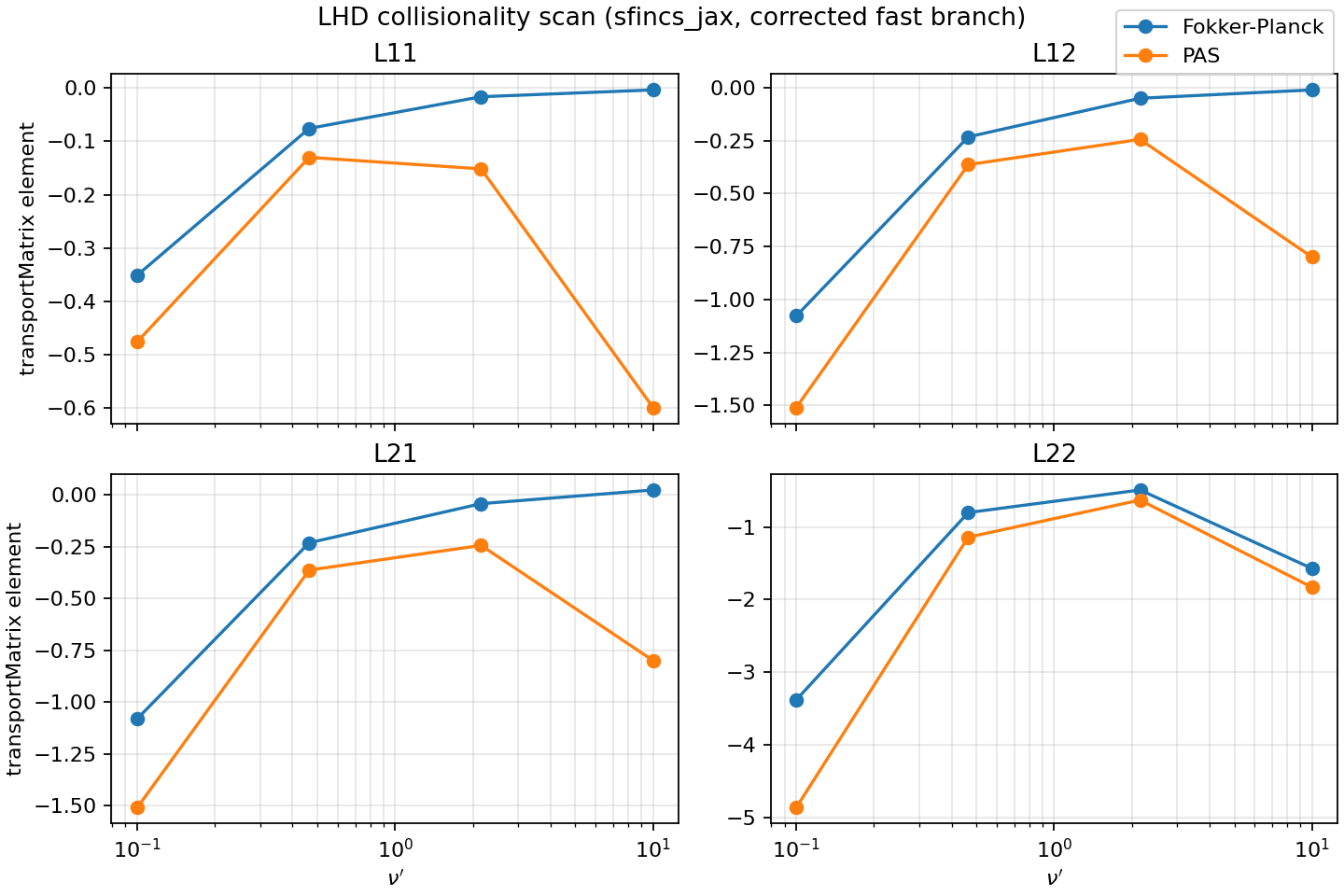
Corrected bounded LHD collisionality rerun with the guarded scan-input writer. This artifact resolves the expected FP/PAS separation and is backed by direct JSON-based assertions, but it is a bounded fast branch lane rather than the final audited paper figure.
bounded corrected W7-X summary:
examples/publication_figures/artifacts/w7x_collisionality_reaudit_fast_summary.jsonbounded corrected W7-X figure:
docs/_static/figures/paper/dkx_fig2_w7x_collisionality_reaudit_fast.png
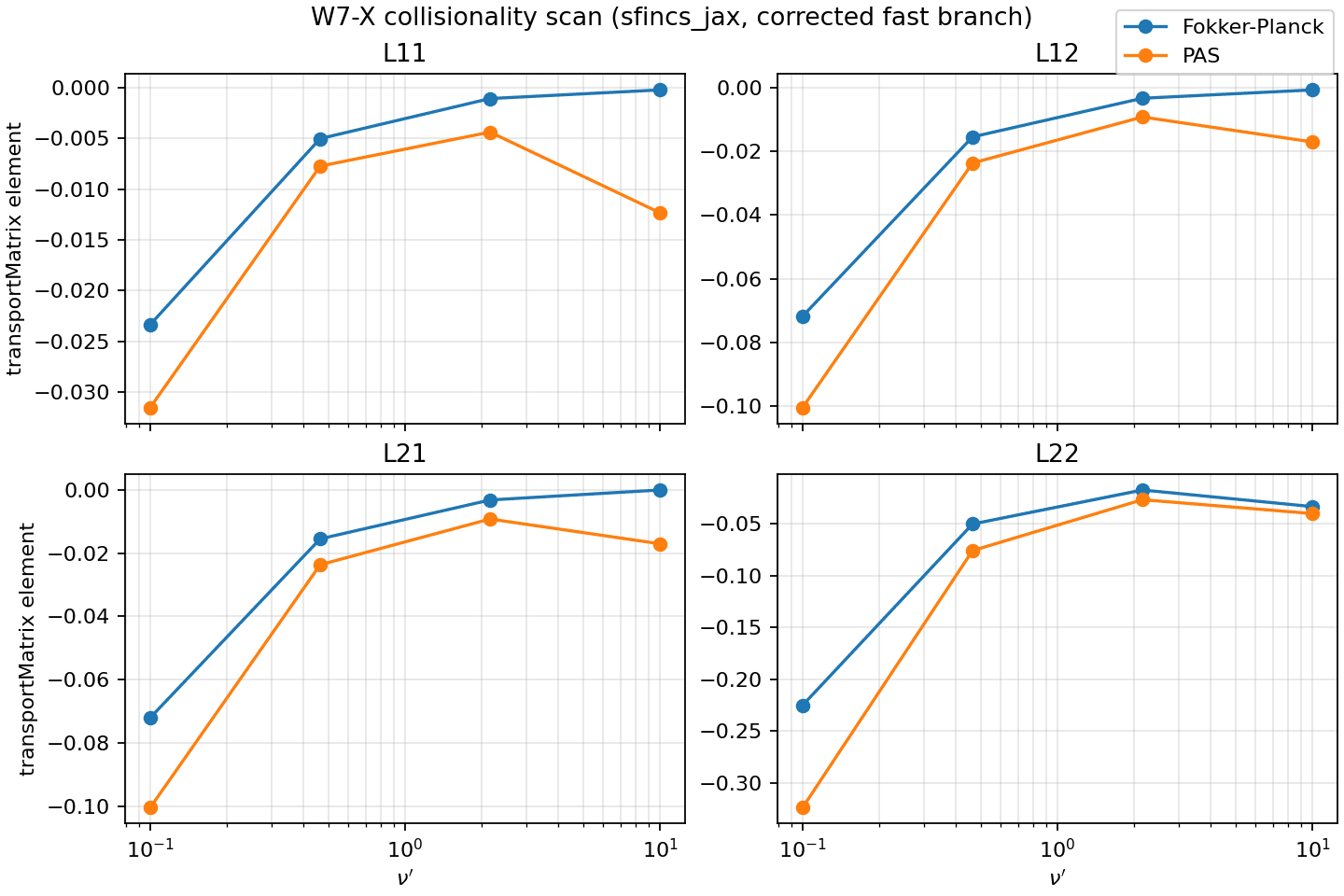
Corrected bounded W7-X collisionality rerun after fixing the scan-input writer. This lane also resolves clean FP/PAS separation and is light enough for branch-level validation, but it remains a bounded fast artifact rather than the final audited paper figure.
Autodiff / sensitivity validation
Literature anchors:
Current script:
examples/publication_figures/generate_autodiff_sensitivity_validation.py
Current artifacts:
examples/publication_figures/artifacts/dkx_autodiff_sensitivity_validation_summary.jsondocs/_static/figures/paper/dkx_autodiff_gradient_check.pngdocs/_static/figures/paper/dkx_autodiff_gradient_check.pdfdocs/_static/figures/paper/dkx_autodiff_sensitivity_map.pngdocs/_static/figures/paper/dkx_autodiff_sensitivity_map.pdf
Fortran-v3 RHSMode 4/5 source-contract gates:
dkx.sensitivity.validate_fortran_v3_adjoint_sensitivity_constraintsmirrors the source-code restrictions fromvalidateInput.F90for adjoint sensitivity decks.dkx.sensitivity.fortran_v3_adjoint_sensitivity_output_fieldspins the sensitivity HDF5 field names emitted bywriteHDF5Output.F90before the numerical Fortran replay fixtures are promoted.dkx.sensitivity.fortran_v3_adjoint_sensitivity_output_ranksandvalidate_fortran_v3_adjoint_sensitivity_output_surfacevalidate the required RHSMode=4/5 field names and tensor ranks against either HDF5-like arrays or lightweight JSON summaries.tests/test_sensitivity.pychecks valid and invalid RHSMode 4/5 decks, including the Fortran source-code gate that writesdParallelFlowdLambdafromadjointParticleFluxOptionordebugAdjoint.tests/fixtures/fortran_v3_reference_fixture.jsoncontains compact RHSMode=4/5 reference summaries and embedded namelist text. The checked W7-X-like analytic decks pin radial-current, heat-flux, total-heat-flux, parallel-flow, bootstrap, and RHSMode=5dPhidPsidLambdasensitivity outputs from SFINCS Fortran v3 without committing generated HDF5 files, includingdRadialCurrentdLambda = sum_s Z_s dParticleFlux_s/dLambdaanddTotalHeatFluxdLambda = sum_s dHeatFluxdLambda_sanddBootstrapdLambda = sum_s Z_s dParallelFlowdLambda_s.small_rhsmode4_debug_summary_2026-06-25.jsonrecords a bounded debug-adjoint finite-difference run. The regression validates every debug field name/rank, selected analytic/finite-difference values, finite percent errors below the checked tolerance, and the Fortran NaN mask for unfilled lambda/mode entries.
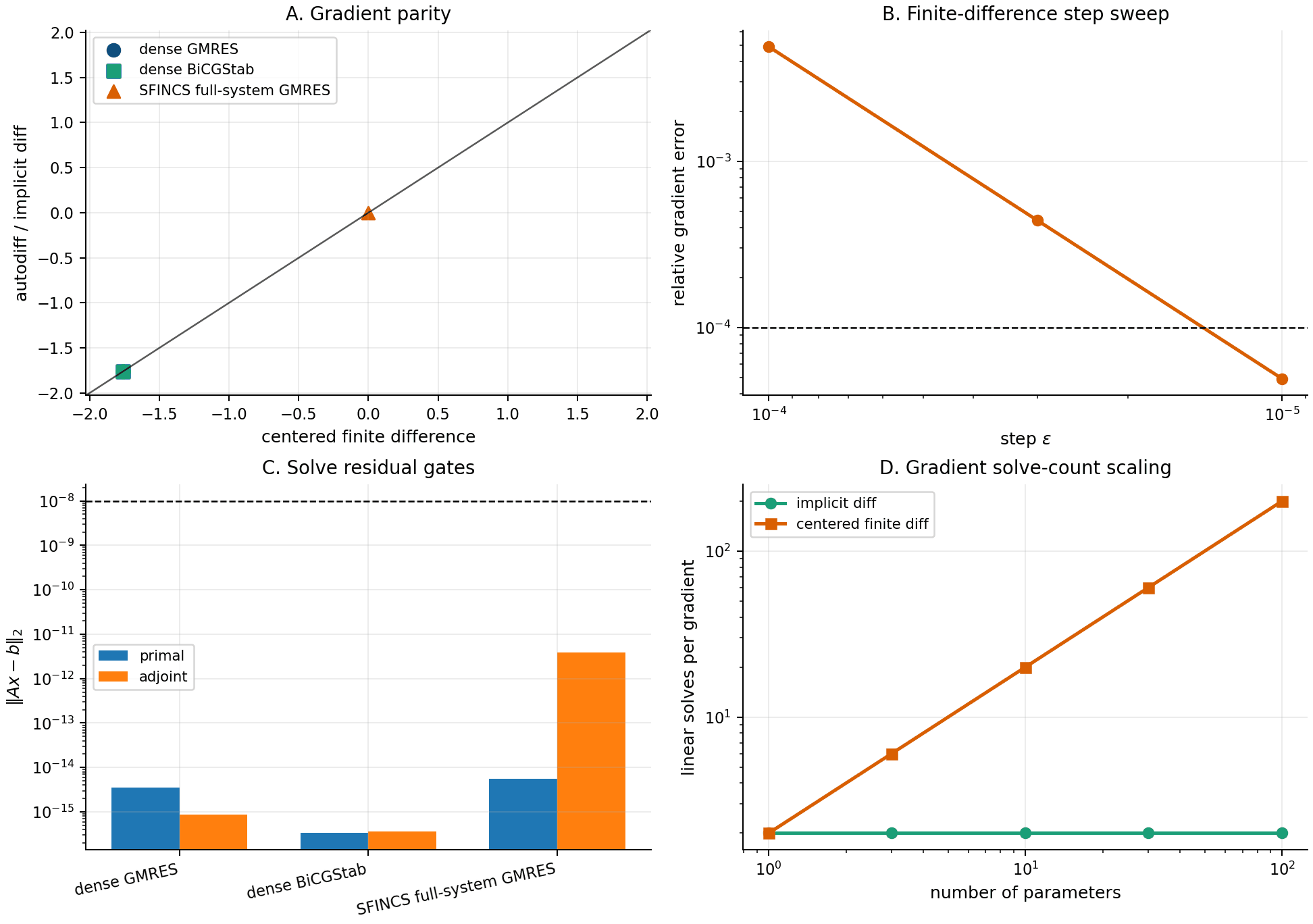
Bounded manuscript-grade autodiff validation. The checked-in summary records centered finite-difference comparisons, primal residuals, and adjoint residuals for custom-linear-solve gradients. The SFINCS full-system panel uses a pinned tiny PAS fixture and validates the implicit-differentiation path without changing production solver defaults.
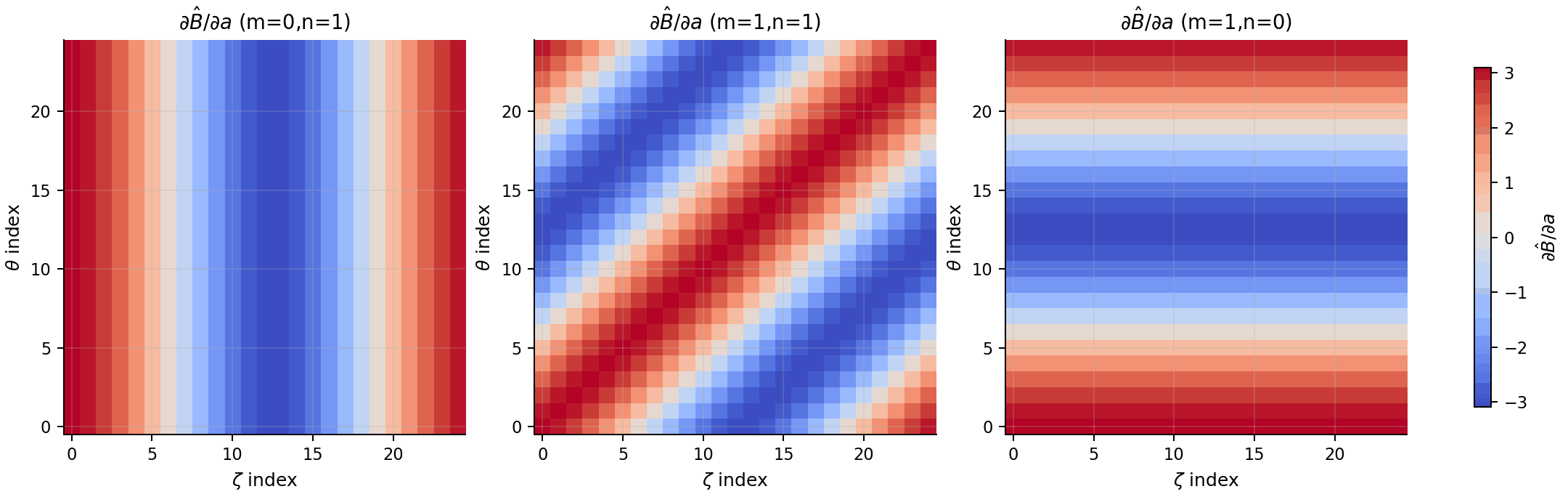
Differentiable geometryScheme=4 Boozer-harmonic sensitivity maps. This
artifact validates the public analytic-Boozer geometry path used by examples and
optimization scaffolds; it does not claim full VMEC-boundary optimization.
Bounded integration lanes
These lanes are useful for integration review, but they are not current-release
publication claims unless and until they are added to
examples/publication_figures/validation_manifest.json with explicit
release_gate metadata.
Open lane board
QI/device-QI solver research: QI seed-robustness, hard-seed GPU campaigns, and device-QI operator-reuse promotion evidence are preserved on the
research/qi-device-hard-seedbranch. They are not release-facing validation artifacts in the stable core. Any future QI/device-QI promotion must restore or regenerate compact artifacts from the candidate branch and pass residual, output, runtime, memory, CPU/GPU parity, solver-trace, and documentation gates before appearing in this matrix.PAS memory/runtime: guarded
tzfftand weak-PAS fail-fast routes are bounded diagnostics. The byte-budgeted geometry4 and HSX real-solve probes are residual-clean and solver-path stable, but they are not promoted because they regress runtime, memory, or both against the checked baselines. Promotion still requires residual-clean CPU/GPU evidence with no parity loss and a measured runtime or memory win on geometry-rich PAS floors.Single-case scaling: transport-worker case/RHS throughput is separately gated, but single-case multi-device strong scaling remains experimental until a warm, compile-amortized, device-covered artifact shows a real speedup.
Coverage/refactor: policy seams and solver helpers have focused tests, but the package-wide
95%target still requires more owner-module tests for profile solves, transport solves, operator assembly, output writing, and a JAX-safe coverage environment.VMEC/Boozer workflow: validation checks cover workflow provenance, optional ecosystem gates, and proxy-gradient consistency. Full VMEC-boundary-to-SFINCS kinetic transport gradients remain deferred.
Deferred validations: W7-X ambipolar validation, high-
nuanalytic-limit extension, broader MONKES/KNOSOS overlap, production-resolution QI ladders, and large geometry-rich PAS claims remain deferred until checked-in numerically gated artifacts and release-gate metadata exist. Production-resolution QI ladders should not launch until the GPU hard-seed gate writes output through a true device route.
Mapped x-grid PAS transport evidence (retired lane)
The mapped x-grid research owners and their tests were deleted with the legacy pipeline (see Speed grids (canonical) and the retired adaptive-map research lane). The bounded artifacts are retained as a historical record:
docs/_static/mapped_xgrid_transport_evidence_rhsmode2_tiny.jsondocs/_static/mapped_xgrid_transport_evidence_rhsmode2_tiny.csvdocs/_static/mapped_xgrid_transport_evidence_reduced_pas_tokamak_rhsmode2.jsondocs/_static/mapped_xgrid_transport_evidence_reduced_pas_tokamak_rhsmode2.csv
Scope and status:
The tiny artifact is a smoke comparison against a small RHSMode=2 PAS fixture.
The reduced PAS tokamak artifact compares mapped
Nx=7candidates against anNx=13reference and records residuals, active-DOF counts, elapsed time, moment-objective diagnostics, and transport-matrix error.The best reduced PAS tokamak candidate by transport error is a bounded evidence point for the opt-in mapped-grid machinery, not a claim that mapped grids should replace default SFINCS-v3-compatible grids.
Full-FP mapped-grid compatibility remains open because the current full-FP collision precompute path still has assumptions that are not yet mapped-grid compatible.
Promotion gates:
add the lane to the manifest with
claim_statusno stronger thanbounded_proxyuntil production-resolution evidence exists,compare against higher-resolution default-grid references, not only same-resolution smoke solves,
demonstrate residual-clean CPU/GPU behavior on at least one representative PAS transport case,
and keep default
xGridSchemebehavior unchanged unless full-suite parity and runtime/memory gates justify promotion.
QI/device-QI research boundary
QI seed-robustness scripts, hard-seed campaign artifacts, and device-QI
promotion tests are preserved on the research/qi-device-hard-seed branch.
The stable core intentionally keeps only general solver-policy and output-schema
contracts. It does not ship QI seed-robustness JSON artifacts, QI promotion
figures, or QI-only example inputs as release evidence.
Promotion gates for any future QI/device-QI return to stable are:
regenerate compact artifacts from the candidate branch,
pass strict true-residual and output-write gates on CPU and GPU,
record solver traces, runtime, and peak-memory budgets,
compare supported observables against SFINCS Fortran v3 where the models overlap,
document the differentiability scope, and
add only the minimal stable source/tests/docs needed for the admitted default.
Solver-path policy refactor
Current source and tests:
dkx/solve.py(the three-tier auto-policy and its tier-selection helpers)tests/test_solve.pyand the solver-trace tests
Scope and status:
Solver-path selection (tier eligibility, memory-based auto-selection, preconditioner construction, residual gates, and recycling) is centralized in
dkx/solve.py; the standalone legacy policy module was retired with the legacy solver packages. Selection decisions are recorded in the versioned solver trace (dkx/solver_trace.py).This is a maintainability and reproducibility gate for solver-path selection. It does not by itself support a new performance or physics claim.
Promotion gates:
keep policy tests green alongside the driver-wrapper tests,
verify no solver-path branch change is promoted without residual-clean and parity-clean artifacts,
and summarize solver-path provenance in release artifacts before using a new branch as a documented default.
Closed post-release research lanes
The following lanes are not release blockers. They are closed in the manifest as
deferred_post_release with explicit criteria for reopening them in a later
research/nightly cycle.
1. Electric-field sweeps
Literature anchors:
[Landreman et al. 2014](https://publications.lib.chalmers.se/records/fulltext/199559/local_199559.pdf)
Publication target:
one tokamak-like case,
one stellarator case,
fluxes, flows, and bootstrap current versus normalized radial electric field,
clear comparison of partial, DKES-like, and full-trajectory models.
Current scaffold:
examples/publication_figures/generate_er_trajectory_sweep.py
This script already implements the correct upstream trajectory-model switches and produces JSON summaries plus 2x2 publication-style figures.
Current fixed artifacts:
audited tokamak-like reference summary:
examples/publication_figures/artifacts/er_sweep_tokamak_reference_summary.jsonaudited tokamak-like reference figure:
docs/_static/figures/paper/dkx_er_trajectory_sweep_tokamak_reference.pngbounded stellarator-like fast summary:
examples/publication_figures/artifacts/er_sweep_stellarator_fast_reference_summary.jsonbounded stellarator-like fast figure:
docs/_static/figures/paper/dkx_er_trajectory_sweep_stellarator_fast_reference.png
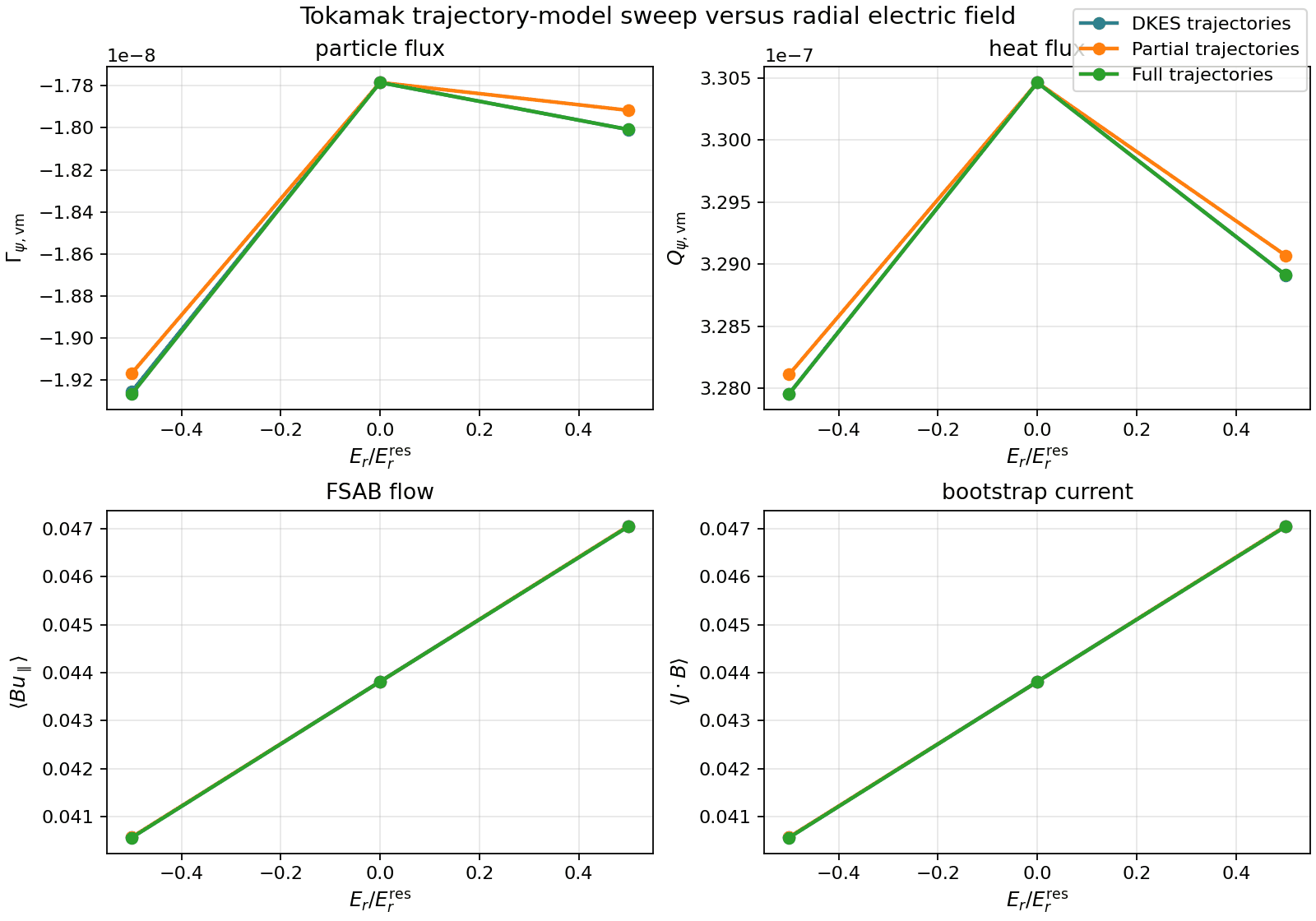
Fixed tokamak-like E_r sweep across DKES, partial, and full trajectory
models. This lane is pinned to checked-in JSON and figure artifacts, and it
is backed by direct numerical assertions on zero-field agreement and
finite-field model separation.
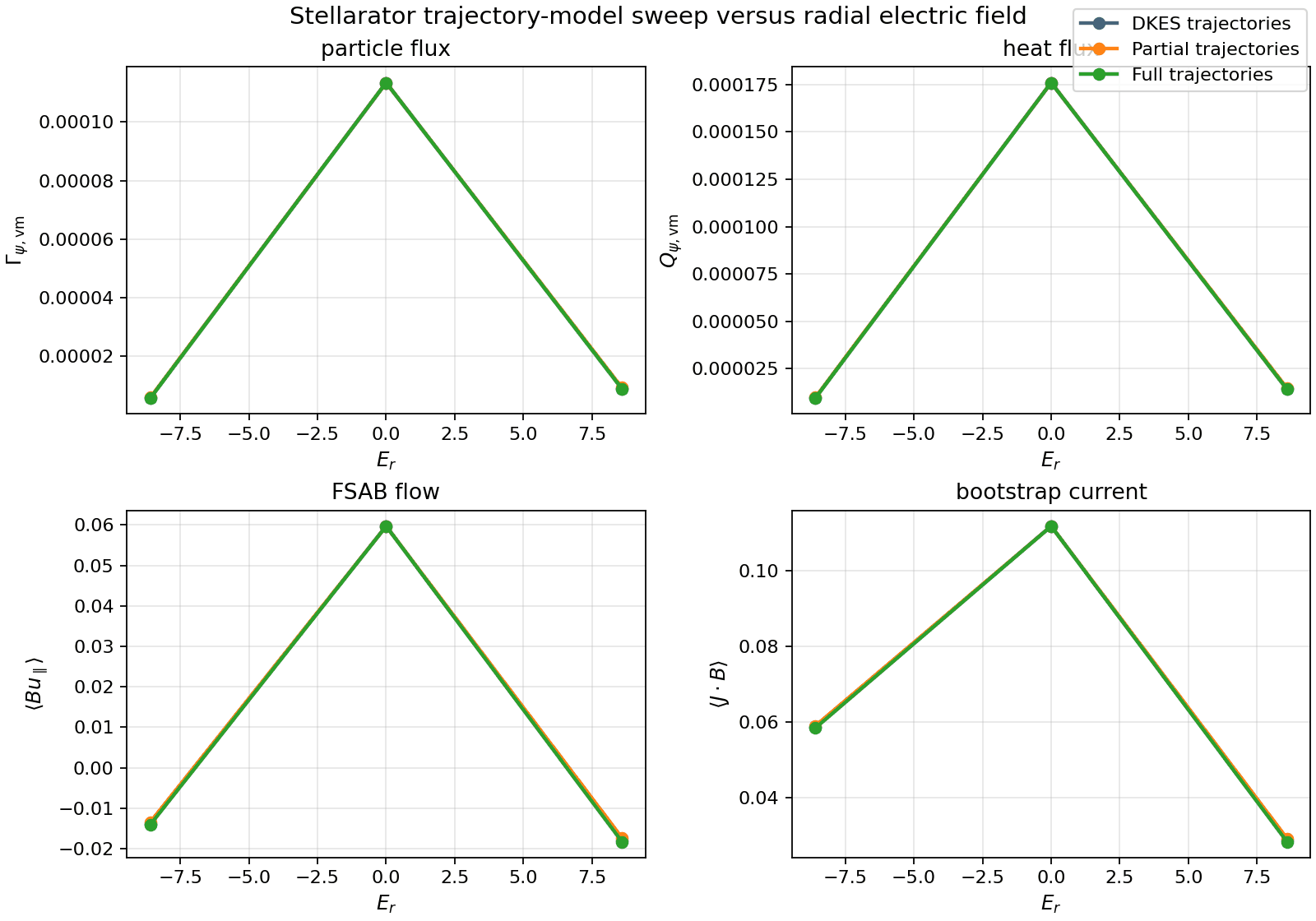
Fixed stellarator-like fast branch scaffold across DKES, partial, and full trajectory models. This is intentionally a bounded branch-validation lane: it resolves the expected model separation on the selected input, but the full-resolution stellarator sweep remains a heavier validation target.
Validation goal:
verify small-field agreement and large-field separation behavior,
make the ordering and crossover behavior explicit in both assertions and figures,
promote the stellarator-like branch scaffold to a full-resolution audited lane only after the runtime/cost tradeoff is acceptable for the release/nightly workflow.
2. High-collisionality proxy after collisionality audit
Literature anchors:
[Landreman et al. 2014](https://publications.lib.chalmers.se/records/fulltext/199559/local_199559.pdf)
Closed branch evidence:
bounded LHD and W7-X fast reruns resolve FP/PAS separation on the same four-point
\\nu'ladders without label collapse in the stored outputsaudited full LHD and W7-X collisionality summaries resolve both FP and PAS labels on seven-point
\\nu'laddersa checked-in trend proxy records high-collisionality tail slopes from those corrected artifacts:
examples/publication_figures/artifacts/dkx_high_collisionality_trend_proxy_summary.jsona checked-in Simakov-Helander normalization audit records the Appendix-B geometry ingredients,
FSABHat2recomputation, inverse-nuslope gates, and explicit readiness status:examples/publication_figures/artifacts/dkx_simakov_helander_limit_audit_summary.json
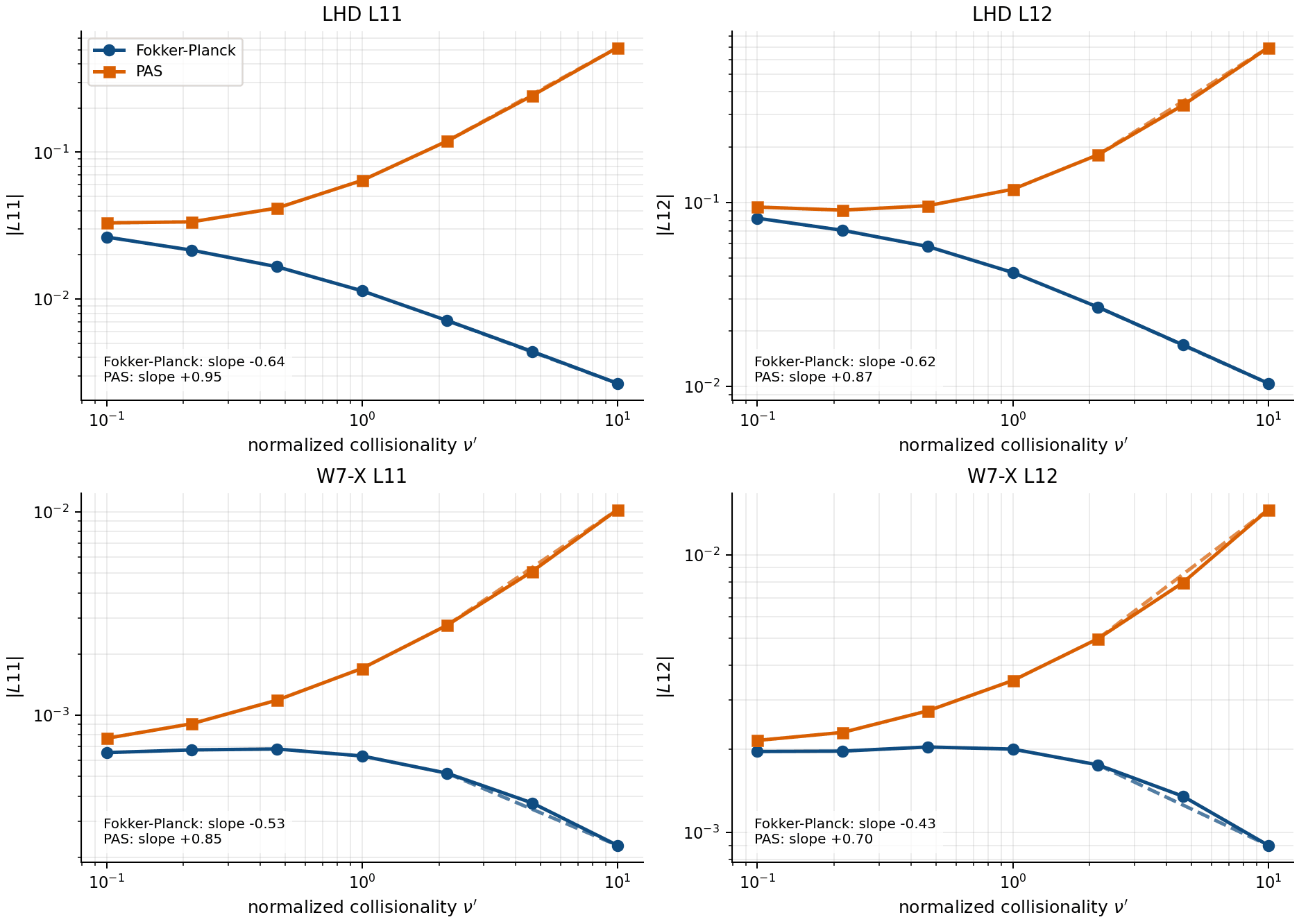
Trend proxy for the L11 and L12 tails. The SFINCS 2014 paper states that
PAS L11/L12 scale like +nu at high collisionality, while
momentum-conserving FP/model-operator results should approach inverse-nu
scaling in the nu' >> 1 limit. The checked-in LHD artifact satisfies the
loose inverse-tail proxy, but the W7-X artifact does not yet. The stricter
Simakov-Helander audit therefore keeps both geometries deferred until wider
high-nu scans are pinned, so this figure is kept as an implemented trend gate
rather than the final analytic-limit reproduction.
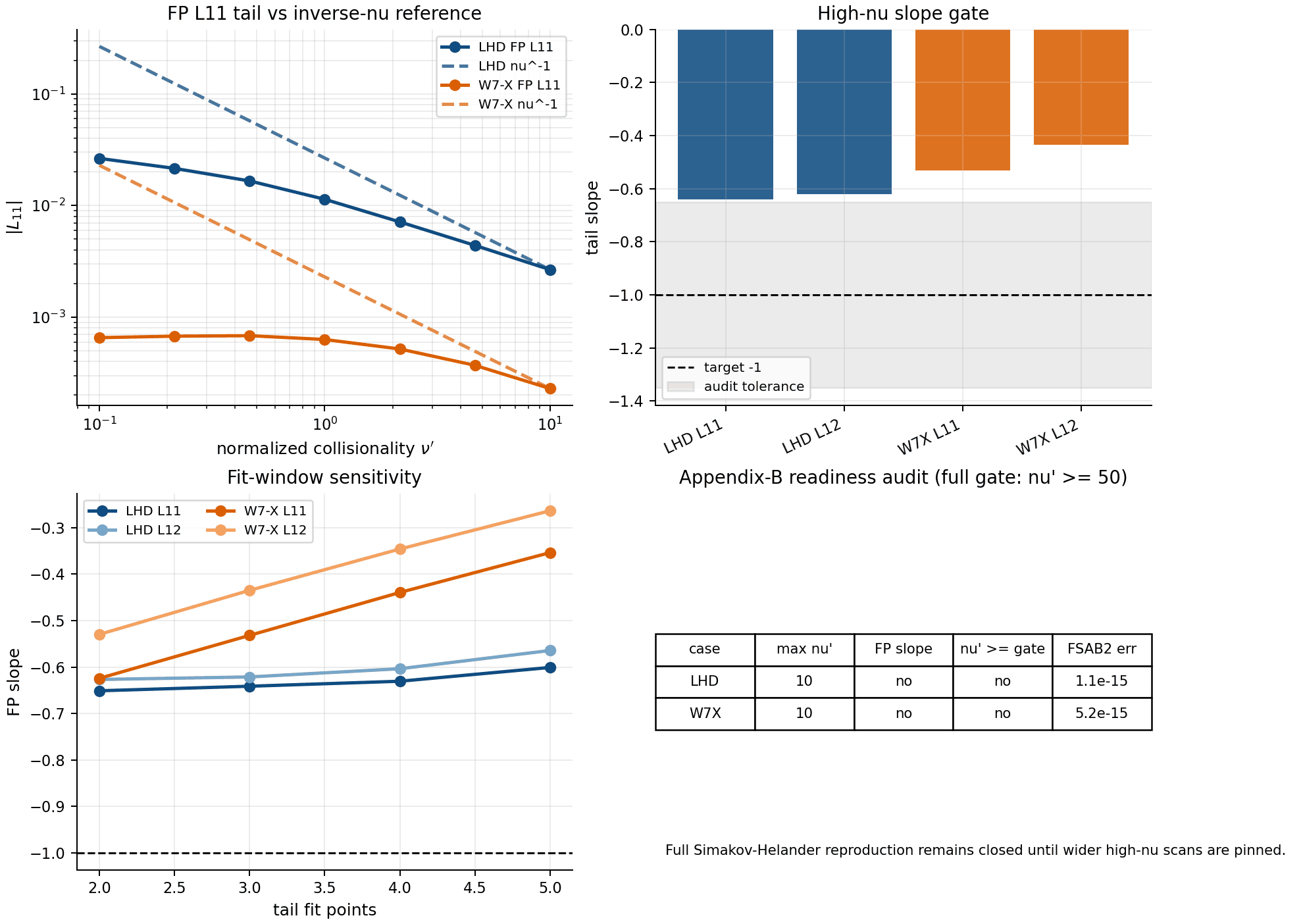
Normalization and readiness audit for the full Simakov-Helander lane. The audit
confirms that checked-in sfincsOutput.h5 files contain the geometry quantities
needed for an Appendix-B comparison, but it keeps the full analytic-limit
reproduction closed because the current full collisionality summaries stop near
nu'=10 rather than a wider nu' >> 1 range. The JSON summary also
carries a recommended logarithmic high-nu' extension grid for each case,
ending near nu' of 100, so the next heavy run is pinned and reviewable.
Post-release acceptance criteria:
keep machine-readable summary artifacts for each full scan,
keep the Simakov-Helander audit artifact in CI as the parent gate for future high-collisionality scan work,
use
examples/publication_figures/artifacts/dkx_simakov_helander_high_nu_run_plan.jsonas the executable high-nu'extension plan; it is generated from the audit and pins LHD and W7-X extension commands ending nearnu'=100,run each plan entry’s
pilot_commandfirst; the first LHD FP pilot atnu'=17.78on the office GPU took about569 sfor one transport point, so the complete FP/PAS LHD+W7-X extension is a nightly/workstation campaign,and only promote the deferred full analytic-limit reproduction after wider high-
nuLHD and W7-X scans are regenerated and the readiness gate flips true.
The run-plan artifact is explicitly labelled as a deferred executable plan. Its
machine-readable gates record that residual thresholds are wired into every command
and that ready_for_literature_claim remains false because no completed high-nu
scan artifact is present yet. Publication panel summaries use the same convention:
publication_figure.claim_status is proxy_or_deferred unless the source JSON is
both numerically gated and checked in as a converged artifact.
A separate W7-X high-nu preconditioner/performance figure is available for the
single first FP point, but it is not a physics-validation lane. Its summary gates
only support the bounded claim that sparse-helper factor reuse is residual-clean,
faster than no-reuse, uses fewer sparse factorizations, and rejects the failed
bounded Krylov route. The figure metadata therefore keeps
ready_for_physics_validation_claim=false.
3. W7-X ambipolar-field validation
Literature anchors:
[Pablant et al. 2020 ion-root context](https://sites.fusion.ciemat.es/jlvelasco/files/papers/pablant2020ionroot.pdf)
[Pablant et al. 2018 W7-X core radial electric field](https://sites.fusion.ciemat.es/jlvelasco/files/papers/pablant2018er.pdf)
[Nature 2021 W7-X neoclassical validation context](https://www.nature.com/articles/s41586-021-03687-w)
Publication target:
one figure comparing neoclassical
E_rand/or heat-flux trends against the published W7-X validation context,one table documenting exactly which approximations and reconstructed inputs were used.
Validation goal:
make any profile reconstruction assumptions explicit,
use this lane only if the reconstructed input set is scientifically defensible.
Stable artifact gate:
dkx.validation.artifacts.build_w7x_ambipolar_root_provenance_panelexamples/publication_figures/provenance/w7x_ambipolar_provenance_template.json
The stable branch keeps the ambipolar solver API, scan/readback tests, and a fail-closed provenance panel builder. Long W7-X scan and figure generation is a publication-audits research workflow until a defensible equilibrium/profile reconstruction is supplied and the resulting source artifact is checked in.
The deferred panel includes explicit acceptance_gates:
finite distinct
E_r/current scan points,finite ambipolar roots,
radial-current sign bracketing,
roots inside the scanned
E_rrange,root consistency with a sign-change bracket,
a resolved local current slope at the accepted root,
an ion-root candidate,
complete equilibrium/profile/discharge/literature provenance,
checked-in source-artifact status,
and the combined
ready_for_literature_claimgate.
Without a provenance JSON containing equilibrium_source, profile_source,
configuration_or_shot, and literature_reference, generated artifacts remain
w7x_like_scaffold rather than w7x_literature_validation.
Even with complete provenance, generated summaries remain
w7x_literature_candidate_deferred until the matching W7-X summary artifact is
checked in; this prevents an exploratory rerun from being labelled as a closed
literature comparison.
Start from
examples/publication_figures/provenance/w7x_ambipolar_provenance_template.json;
it is intentionally incomplete and should be copied/finalized for a specific
equilibrium/profile reconstruction before any literature-facing W7-X claim.
Closure note:
the stable core keeps the ambipolar solver and provenance/artifact gate tests,
the checked-in literature artifact and long generator are intentionally absent,
this lane is classified as
deferred_post_releaseuntil a defensible W7-X input reconstruction is run and its summary/figure are pinned in the repository.
4. MONKES / KNOSOS overlap
Literature anchors:
[MONKES paper](https://arxiv.org/abs/2312.12248)
[KNOSOS paper](https://arxiv.org/abs/1908.11615)
Publication target:
coefficient overlap on monoenergetic shared-model subsets,
low-collisionality trend comparison where the models are not exactly identical.
Validation goal:
separate exact overlap claims from qualitative trend/ordering claims,
keep this lane focused on the model subset that is genuinely comparable.
How this page should evolve
Each time a new figure lane is implemented, update both:
this page,
and
examples/publication_figures/validation_manifest.json.
That keeps the manuscript-facing validation story synchronized with the code structure and the test/benchmark infrastructure.